
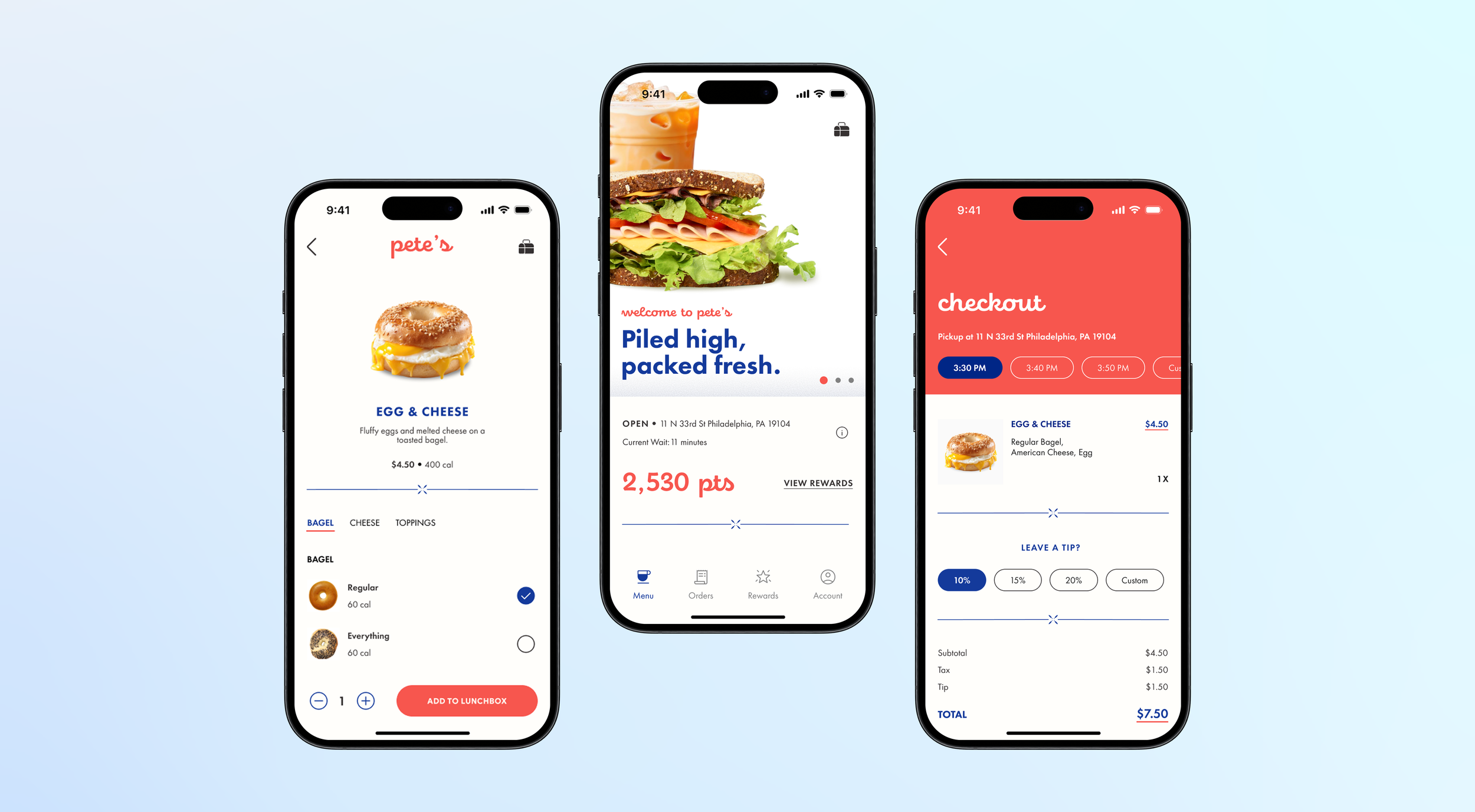
Designing a fast & friendly mobile ordering experience for a food truck that runs on regulars.
PETE’S LITTLE LUNCH BOX
AT A GLANCE
Pete's Little Lunch Box is a small, beloved food truck parked outside Bentley Hall on Drexel's campus, known for a convenient breakfast, its friendly employees, and a loyal community of regulars. My team set out to design a digital ordering experience that matched the fast-paced, student-centered culture of the truck - one that would reduce line buildup during peak rushes without losing the personal, familiar feel that keeps people coming back.
I led our research and kept the project organized from observation through final prototype, while also shaping the core UX flows and the visual layout of the app.
ROLE & TEAM
User Research, Project Organization, UX/Interaction Design, Layout & Visual Design alongside Shannon Jaya, Ashley Nguyen, and Maayan Chashper
SKILLS
Figma
Adobe Suite
Usability Testing
UX Research
TIMELINE
Sep 2025 - Dec 2025
IMPACT

✅
95%
completion rate amongst primary tasks in the app across 20+ user tests.

🤳
3/10 → 8–10/10
likelihood-to-use score, from paper prototype to final high-fidelity design.

🥡
100%
of users believed this app would make ordering from pete’s more convenient.
PROBLEM
A predictable rush was creating an unpredictable wait.
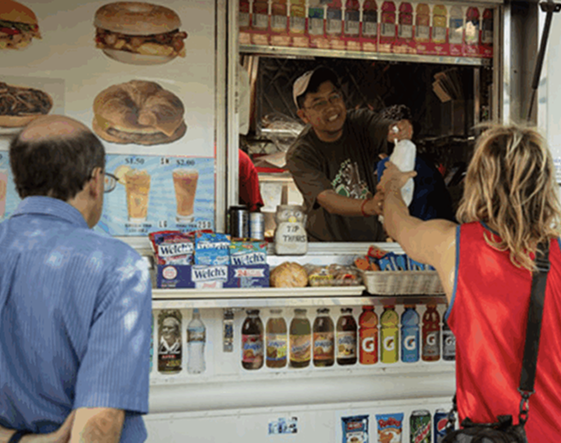
Like many campus food vendors, Pete’s Little Lunch Box operates on a predictable but time-sensitive rush pattern. Lines can form rapidly around noon as students pass between classes, and workers often need to place orders quickly while on their break. Because the menu is small and most customers are regulars, people tend to order immediately without browsing, but bottlenecks still form during the peak window. Customers typically wait between 1–6 minutes depending on the order, and many pass the time listening to music, scrolling on their phones, or paying through Venmo while they wait.
The main challenges include:
⏱️
Rush hour bottlenecks
Lines form fast around noon as students pass between classes and workers order on short breaks. Wait times run 1–6 minutes, but even that is enough to create a backup at a single window.
📱
Most orders already decided upon
Most customers aren't browsing — they arrive with their order memorized or already pulled up on their phone. A menu-first app would slow people down, not speed them up.
💳
In-person only payments
The truck runs almost entirely on a taped-up Venmo QR code and cash. Any digital solution had to enhance that familiar, low-friction system instead of replacing it with something more complicated.
This led us to design based off of a guiding question:

"How might we help customers order and pick up their food quickly and predictably, without losing the personal, community feel that makes Pete's, Pete's?"
INITIAL RESEARCH
The opportunity wasn't adding features - it was matching the pace people already move at.
The challenge for our team was to design an ordering experience that minimized wait times, reduced congestion at the truck, and gave customers more flexibility in how and when they pick up their food, without disrupting the friendly, casual culture the truck is known for. Additionally, because the current business relies heavily on in-person interactions and simple payment methods, we needed to introduce digital features that enhanced, rather than complicated, the existing workflow. This meant balancing convenience with familiarity.
Fly-on-the-Wall Observation Study
To understand Pete's before designing, I conducted an individual fly-on-the-wall observation during the lunch rush, tracking how customers approached the truck, decided what to order, waited, paid, and left. My team then combined our individual observations into a single set of findings:
Most customers were regulars who ordered without checking the menu
Payment was overwhelmingly digital (Venmo, with some cash)
The wait itself was filled with phone-scrolling, music, and small talk
Project & Business Model Canvas
From there, I helped build out our Project Canvas and Business Model Canvas in FigJam - mapping the team's goals, target users, risks, and milestones alongside Pete's key partners, resources, value props, and revenue streams. This gave us a shared foundation before any research synthesis began: our primary users were college students 18–24 looking for a quick, satisfying meal, with professors and local workers as secondary and tertiary segments.
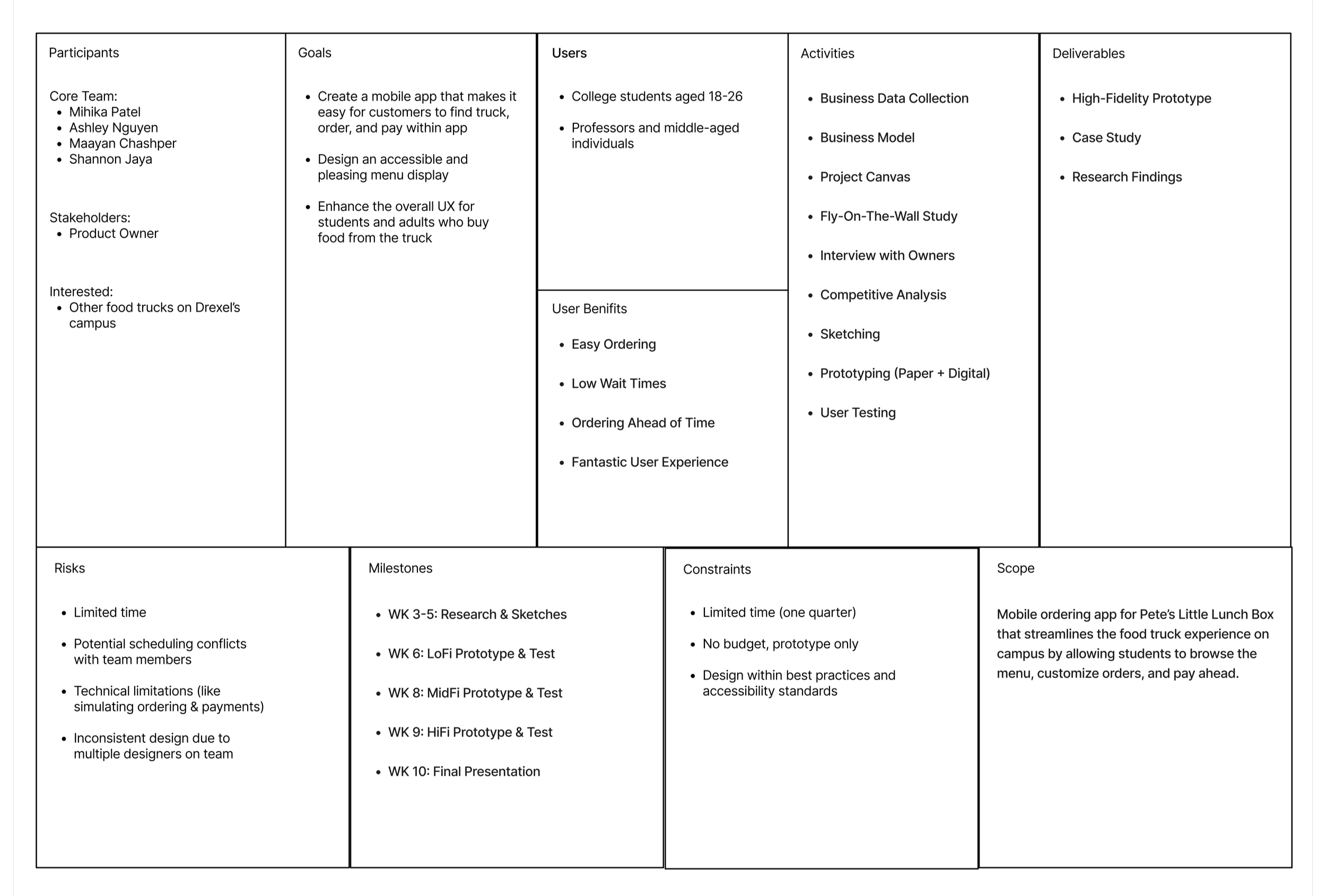
Project Canvas:
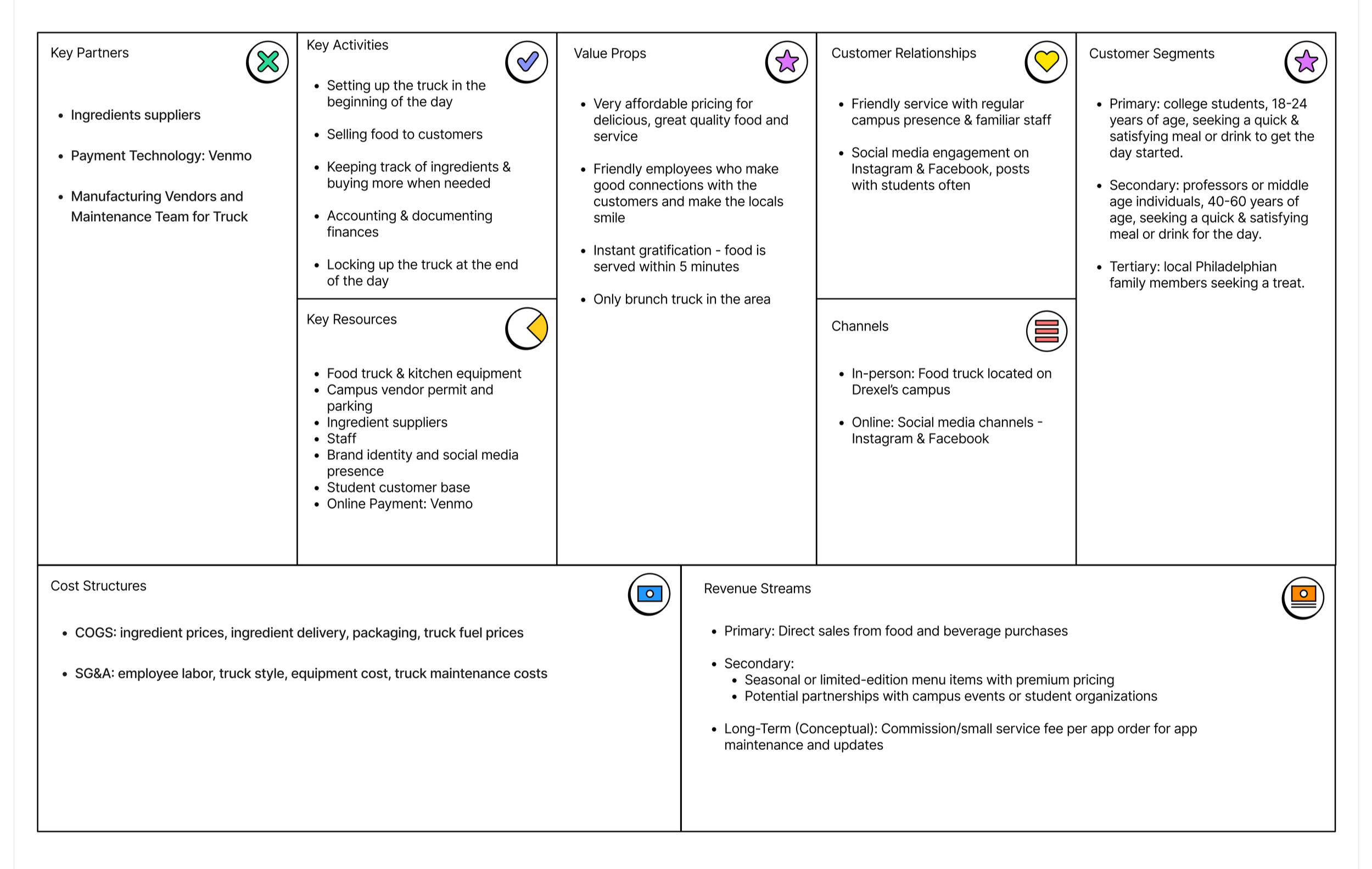
Business Model Canvas: